Showing posts with label Law of God. Show all posts

Saturday, April 7, 2007

Igniting the Fire of the Sabbath Truth of Jesus Christ

I believe that Christ kept all the Commandments of God, because the Bible says that He did no sin (Heb. 4:15), even though He came in the likeness of our sinful flesh, the God/man, our human-Divine Mediator (Romans 8:3). He set the example for us in our humanity as to how we are to live--to reflect His character, even as He reflected the character of the Father. We can only reflect, we cannot be the source as He and the Father are.

Therefore, I believe that Jesus Christ did keep the Sabbath fully as humanity must keep it, as well as the other nine commandments (Exodus 20:1-17). He had the Spirit of the Law, and if you have the Spirit of the Law, you will also have the works of the Law. Many people have the works and no spirit, and we cannot be saved by the works of the Law. And what good is the Spirit of the Law unless we practice what we believe to be true?  We must be born again (John 3:3), following the Spirit and not the carnal flesh (Romans 8). Christ did the works of the Law, but that was because He was full of the Holy Spirit, and He loved the Law of God, and it was seen to be written in His heart. (Psalm 40:8.)
Therefore, Christ fulfilled His own and the Father's Ten Commandment Law, as well as the biblical statutes and judgments which explain the Law, living it fully and joyfully, showing that sinful humanity when connected to divinity by FAITH in Christ their Saviour, can keep the Law of God. Although He was perfect in how He lived, we can only strive towards perfection as we trust Him.  He also fulfilled the ceremonial system, not that we are to keep it, no! but that He might show us its purpose and meaning which foreshadowed His work of saving us from sin. He is the Lamb of God which taketh away the sin of the world (John 1:29).   He was slain from the foundation of the world via the symbolism of the sacrificial system, and now memorialized in the Communion Service (Revelation 13:8). He was sacrificed once for us, bringing an end to the sacrificial system, for that was only a shadow of the reality of who He was, Jesus Christ, the offering for our sins (Colossians 2:14-17). The yearly feast days, the yearly feast sabbaths (not seventh-day Sabbaths) and sacrifices and offerings for sin were no longer necessary, for they all pointed forward to Christ, the true Sacrifice.

The weekly Sabbath is the memorial of our Creator, and identifies Him and His position: the Lord God who made the heaven and the earth, the sea and all that in them is, in six days and rested the seventh day (Exodus 20:8-11). The weekly Sabbath is also a memorial of His creative power to make us new Creatures in Him. He was the Redeemer who brought us out of Egypt, out of slavery to sin (Exodus 20:1-3) So it memorializes that He is the one who is sanctifying us, making us holy and victorious over sin. 'We cannot overcome sin without Him. The Sabbath is His sign to His true people who have the Law written in their hearts, that He is the Lord who is sanctifying them. See Exodus 31:12-17 and Ezekiel 20:12, 20, etc. The Sabbath therefore is the sign of the New Covenant. (Hebrews 8:8-12). It surpasses Sunday which is entirely a man-made holiday established by the papacy, not being commanded by God in the Bible at all. The Lord's Day of the Bible is only found to be the Sabbath, the seventh day of the week. Unfortunately one has to go to the traditions of the so-called early Church Fathers (who are not inspired of God) to find reason to make Sunday the Lord's Day. I praise the Lord for His truth and creative power to work in us through the Holy Spirit, and that the Bible teaches us the truth!

I hope these biblical truths will catch like wildfire, to God's glory.

Wednesday, March 21, 2007

God's Covenant with Israel

Psalm 111 is well-worth reading and studying. God says in this passage, "He will ever be mindful of His covenant. All His commandments are sure. They stand fast for ever and ever. He hath commanded His covenant for ever."

What covenant is being referred to? His covenant which contains His commandments which stand fast forever and ever. What is His covenant?

Exodus 34:28 "And he was there with the LORD forty days and forty nights; he did neither eat bread, nor drink water. And he wrote upon the tables the words of the covenant, the ten commandments."

Deuteronomy 4:13 "And he declared unto you his covenant, which he commanded you to perform, even ten commandments; and he wrote them upon two tables of stone."

So if the Ten Commandments, His covenant, stands fast for ever and ever, then what is the Old Covenant and what is the New Covenant? What is the difference?

The Old Covenant, called the "first," existed before the cross of Christ, the New Covenant has existed since the cross of Christ. The first was established with the sacrificial animals that had no blemish, i.e., with the blood of these animals, while the second was established with the blood of Christ. The first foreshadowed Christ and was just as good as the real, but the second cancelled the first because it was the real. When you have the real thing to establish the covenant, you no longer need the shadow to establish it.

The first covenant would have been perfect except that it was not possible for the people to obey or keep the promises on their part, as they lost sight of the fact that the sacrifices were only the shadow of Christ in whom they really needed to believe. The sacrifices had to be offered over and over again, though God had no pleasure in them. To obey is better than sacrifice. (See Micah 6:6-8). Christ came to establish the second covenant by sacrificing Himself once for all, for that was all the sacrificing that was needed. Because He lived a perfect life, keeping all the Ten Commandments perfectly from the heart, He promises to give us His grace to overcome sin under the New Covenant, otherwise we would still be living under the Old Covenant which has passed away, trying to work our way into heaven by doing the works of the Law, but hating the Law at the same time. If the Law of God is written in the heart, supreme love for God, and unselfish love for one another would be the result on a daily basis. There would be no hating righteousness, or failing to find victory in Jesus.

Please read these verses:

Heb 8:7 For if that first covenant had been faultless, then should no place have been sought for the second.
Heb 8:8 For finding fault with them, he saith, Behold, the days come, saith the Lord, when I will make a new covenant with the house of Israel and with the house of Judah:
Heb 8:9 Not according to the covenant that I made with their fathers in the day when I took them by the hand to lead them out of the land of Egypt; because they continued not in my covenant, and I regarded them not, saith the Lord.
Heb 8:10 For this is the covenant that I will make with the house of Israel after those days, saith the Lord; I will put my laws into their mind, and write them in their hearts: and I will be to them a God, and they shall be to me a people:
Heb 8:11 And they shall not teach every man his neighbour, and every man his brother, saying, Know the Lord: for all shall know me, from the least to the greatest.
Heb 8:12 For I will be merciful to their unrighteousness, and their sins and their iniquities will I remember no more.
Heb 8:13 In that he saith, A new covenant, he hath made the first old. Now that which decayeth and waxeth old is ready to vanish away.


Heb 10:1 For the law having a shadow of good things to come, and not the very image of the things, can never with those sacrifices which they offered year by year continually make the comers thereunto perfect.
Heb 10:2 For then would they not have ceased to be offered? because that the worshippers once purged should have had no more conscience of sins.
Heb 10:3 But in those sacrifices there is a remembrance again made of sins every year.
Heb 10:4 For it is not possible that the blood of bulls and of goats should take away sins.
Heb 10:5 Wherefore when he [Jesus] cometh into the world, he saith, Sacrifice and offering thou wouldest not, but a body hast thou prepared me:
Heb 10:6 In burnt offerings and sacrifices for sin thou hast had no pleasure.
Heb 10:7 Then said I, Lo, I come (in the volume of the book it is written of me,) to do thy will, O God.
Heb 10:8 Above when he said, Sacrifice and offering and burnt offerings and offering for sin thou wouldest not, neither hadst pleasure therein; which are offered by the law;
Heb 10:9 Then said he, Lo, I come to do thy will, O God. He taketh away the first, that he may establish the second.
Heb 10:10 By the which will we are sanctified through the offering of the body of Jesus Christ once for all.


The common denominator of the two covenants is the Law of God, did you notice? The first Covenant was the Ten Commandments, and the perfect animal sacrifices in the sacrificial services which established the Law, represented Christ coming some day to live a perfect life in obedience to the Ten Commandments in sinful flesh, and then offering Himself as a perfect sacrifice for our sins to pay the price of our sins. Only then He could write His Law in our hearts and minds. The second or "New" Covenant was established by the real sacrifice for sin, Christ dying on the cross of Calvary for our sins. Because Christ who lived in sinful flesh but did not sin (Hebrews 4:15, Romans 8:3, 4) died in our place, He who lives again will give us grace that we might also obey His Law. How? by writing the Ten Commandment Law in our hearts and minds so that we could overcome sin. The New Covenant is the same Covenant as the old but it is founded on better promises and that is what makes it New and everlasting. Christ rose from the dead, securing His right as our High Priest, so that He might save us from death by administering to us His grace. Praise the Lord!

If we believe on the Lord Jesus Christ, confessing our sins to Him, we should also believe that He pardons us, and gives us more grace to overcome sin through the Holy Spirit which He gives to every follower who asks. Then only can we truly render that heartfelt obedience to His Ten Commandment Law. It is only by the blood of the Lamb of God (John 1:29, 1 John 1:7, 9) that we are saved. Our obedience is the fruit of what Christ does for us and in us. He gets all the glory!

God bless and have a great day in the Lord Jesus Christ.

Friday, March 16, 2007

God does have a Law!!

There are many things people think of when you mention ~~God's Law~~. Some think you are talking of the ceremonial law of Moses. Others think that God's Law is an outdated Law which should be memorialized in courthouses and other public places for historical purposes. Others think of God's Law as the sacred precepts written on two tables of stone which were once broken, and which no one can possibly keep or fully obey today. Praise the Lord, there are still some today who highly regard God's Law as the 10 sacred commandments spoken and written by God to all Israel, that it is still His just, perfect and holy Law for us to keep today. (Romans 7 and 8)

Which view is correct? Let us see what the Bible actually says:

1. Exodus 24:12 "And the LORD said unto Moses, Come up to me into the mount, and be there: and I will give thee tables of stone, and a law, and commandments which I have written; that thou mayest teach them."
2. Exodus 31:18 "And he gave unto Moses, when he had made an end of communing with him upon mount Sinai, two tables of testimony, tables of stone, written with the finger of God."

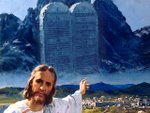
Unfortunately, the children of Israel sinned worshipping the golden calf, and Moses in his anger smashed the commandments to pieces by throwing them down, showing that Israel had broken God's Law. After God forgave those who repented, He asked Moses to bring two new tables of stone up the mountain, then God wrote on them the same Ten Commandments as at the first. So whether or not they were broken, they were still to be kept.

3. Deuteronomy 10:1-5 "At that time the LORD said unto me, Hew thee two tables of stone like unto the first, and come up unto me into the mount, and make thee an ark of wood. And I will write on the tables the words that were in the first tables which thou brakest, and thou shalt put them in the ark. And I made an ark of shittim wood, and hewed two tables of stone like unto the first, and went up into the mount, having the two tables in mine hand. And he wrote on the tables, according to the first writing, the ten commandments, which the LORD spake unto you in the mount out of the midst of the fire in the day of the assembly: and the LORD gave them unto me. And I turned myself and came down from the mount, and put the tables in the ark which I had made; and there they be, as the LORD commanded me."

This Law is called God's Law, it is never called the Law written by Moses. It was handed to Moses, but God wrote it with His own hand, after He had told it with His own voice to Israel.

The Law of God is found in Exodus 20:1-17 and reads:

Exo 20:1 And God spake all these words, saying,

Table One contains Supreme Love For God --

Exo 20:2, 3 I am the LORD thy God, which have brought thee out of the land of Egypt, out of the house of bondage. [Here God proclaims to be their Saviour who has delivered them.] Thou shalt have no other gods before me.
Exo 20:4-6 Thou shalt not make unto thee any graven image, or any likeness of any thing that is in heaven above, or that is in the earth beneath, or that is in the water under the earth: Thou shalt not bow down thyself to them, nor serve them: for I the LORD thy God am a jealous God, visiting the iniquity of the fathers upon the children unto the third and fourth generation of them that hate me; And shewing mercy unto thousands of them that love me, and keep my commandments.
Exo 20:7 Thou shalt not take the name of the LORD thy God in vain; for the LORD will not hold him guiltless that taketh his name in vain.
Exo 20:8-11 Remember the sabbath day, to keep it holy. Six days shalt thou labour, and do all thy work: But the seventh day is the sabbath of the LORD thy God: in it thou shalt not do any work, thou, nor thy son, nor thy daughter, thy manservant, nor thy maidservant, nor thy cattle, nor thy stranger that is within thy gates: For in six days the LORD made heaven and earth, the sea, and all that in them is, and rested the seventh day: wherefore the LORD blessed the sabbath day, and hallowed it.

Table Two contains Unselfish Love For Man --

Exo 20:12 Honour thy father and thy mother: that thy days may be long upon the land which the LORD thy God giveth thee.
Exo 20:13 Thou shalt not kill.
Exo 20:14 Thou shalt not commit adultery.
Exo 20:15 Thou shalt not steal.
Exo 20:16 Thou shalt not bear false witness against thy neighbour.
Exo 20:17 Thou shalt not covet thy neighbour's house, thou shalt not covet thy neighbour's wife, nor his manservant, nor his maidservant, nor his ox, nor his ass, nor any thing that is thy neighbour's.

Though these Ten Commandments called the Law of God are old, are they outdated? No. Are they still necessary to be kept today for man's best good and happiness? Yes. Everyone needs to come to an intelligent decision regarding God's Law, for the breaking of the Law is Sin (1 John 3:4) and the wages of Sin is Death (Romans 6:23). If we daily choose to have Christ Jesus as our Saviour from sin, who also is our Creator and Lawgiver, then we should also want to daily ask for His help to live in obedience to His will, keeping His commandments. It is His will that we have eternal life through Him (Romans 6:23, Revelation 22:14).

May God help each one of us to love Him and keep His Commandments. Read 1 John and note how many times "commandments" appear as well as the word "love!" They are the Great Law of Love, for God is Love.

Tuesday, March 6, 2007

Should Christians keep all Ten of God's Commandments?

Should Christians, who love Jesus Christ and have believed on Him as their personal Saviour from all sin, and have asked Him to dwell in them by the Holy Spirit, keep all Ten of God's Commandments which constitute God's holy, just and perfect Law?

Most devoted Christians believe they are keeping God's Law, and if they aren't that somehow Christ will make up the difference. It would be well to examine the Ten Commandments which were spoken by God to the nation of Israel, and which were written on tables of stone by God's own finger for the nation of Israel, to see what the commandments read, and to see if they are necessary to be kept today.

Christian, if you have your Bible, read Exodus 20:1-17, and tell us which commandments would no longer be valid today, and why? You may respond to this email address:
shelley.senner@gmail.com or post on comment section. God bless, and have a wonderful day!